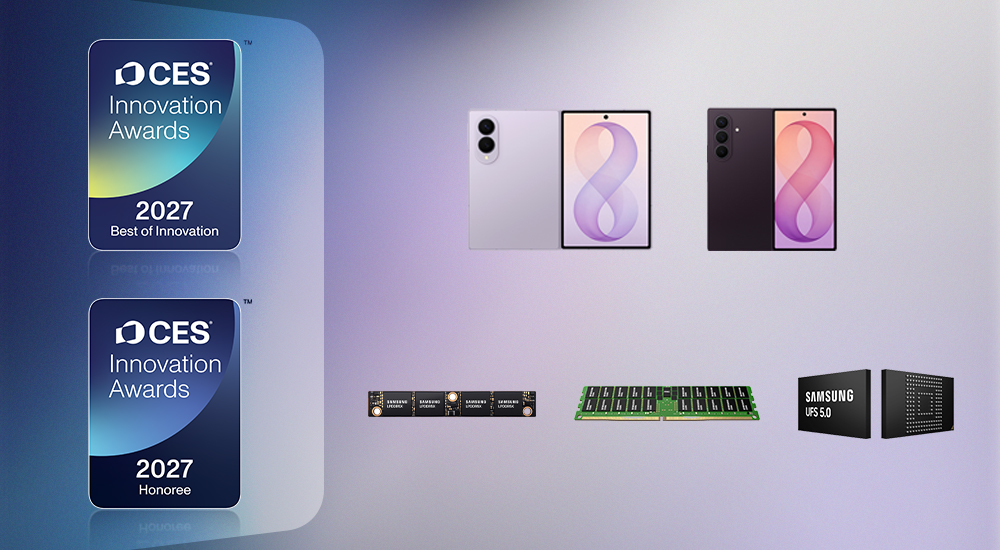
Hooking the Future of Consumer Tech
As mobile architecture and silicon engineering reach new heights of efficiency, consumer technology is undergoing a quiet, structural transformation. We are moving away from an era defined by raw power consumption toward a landscape where sophisticated capabilities operate silently in the background of everyday life. Where is mobile and semiconductor design heading next? The Consumer Technology Association’s CES® 2027 Innovation Awards provide an unmistakable blueprint. Samsung Electronics doubled its prestigious "Best of Innovation" award wins from 2026 to 2027, signaling an industry-wide shift toward hardware designed to run invisible, background processes seamlessly.
Rather than relying on flashy, superficial gimmicks, this year's honorees highlight a fundamental commitment to physical durability, architectural efficiency, and silicon engineered ground-up for artificial intelligence. From paper-thin foldables featuring dual-layer titanium matrices to high-throughput memory architectures built for local generative AI workloads, Samsung’s latest breakthroughs prove that true innovation isn't just about raw speed—it's about removing operational friction. Ahead of the official event, five standout innovations reveal how the hardware running tomorrow's ecosystem is being fundamentally rewritten.
The Impossible Physics of the Galaxy Z Fold8 Ultra (Thinner, Yet Bigger Battery)
The Galaxy Z Fold8 Ultra—winner of the CES 2027 Best of Innovation award in the Mobile Devices, Accessories & Apps category—resolves a long-standing structural paradox in foldable engineering. Historically, shaving millimeters off a device's depth required sacrificing internal volumetric space, resulting in compromised battery capacities or scaled-down camera modules. The Z Fold8 Ultra upends this compromise entirely: it achieves Samsung's slimmest foldable profile to date at just 4.1mm when unfolded and a mass of 215g, while simultaneously packing a 5,000mAh battery—the largest ever integrated into a Galaxy Z Fold.
This volumetric breakthrough relies on Samsung's new Flex Titanium display architecture. By employing dual titanium-based layers within the panel stack, the display-module thickness is reduced by 10% while structural rigidity is increased. This mechanical space-saving directly frees up the chassis volume needed for the 5,000mAh cell while producing a distinctly flatter 8-inch main screen with minimized crease visibility.
"Flex Titanium architecture uses dual titanium-based layers to enhance durability while reducing display-module thickness by 10%, creating more space for internal components..."
Beyond physical dimensions, the optical assembly sees a massive generation-over-generation upgrade. The Z Fold8 Ultra incorporates a 200MP main camera capable of full-resolution HDR shooting, alongside a revamped 50MP F1.9 ultra-wide sensor. Replacing the 12MP ultra-wide found on the Z Fold7, this new 50MP module adds macro capability and captures approximately 34% more light due to its wider aperture.
By simultaneously conquering volumetric limits, battery density, and optical compromise, the Z Fold8 Ultra eliminates the legacy trade-offs that previously held back power users. Resolving this engineering tension turns the ultra-thin foldable from a luxury experiment into an uncompromising primary workstation.
UFS 5.0 is the Unsung Hero of On-Device Generative AI
While user-facing software features dominate AI marketing, internal memory bandwidth dictates real-world responsiveness. Named a CES 2027 Innovation Awards Honoree, Samsung’s UFS 5.0 storage solution arrives as the mobile industry's first storage architecture optimized specifically for local, on-device artificial intelligence.
As mobile ecosystems move away from cloud reliance toward agentic AI—where autonomous agents execute multi-step tool workflows, maintain persistent contextual memory, and perform real-time local Retrieval-Augmented Generation (RAG)—storage access latency becomes the dominant bottleneck. UFS 5.0 directly clears this computational bottleneck across several operational fronts:
- Data Throughput: Delivers interface bandwidth reaching up to 10.8 GBps, doubling the sequential read and write speeds of UFS 4.1.
- Algorithmic Random Read Acceleration: Integrates a proprietary Samsung algorithm that boosts random read performance across large memory blocks by over 3.4 times, cutting model startup and context-retrieval latency.
- Component Footprint: Available in 512GB and 1TB capacities, the physical package size is reduced by 16.7% compared to the prior generation, opening up thermal headroom and battery space.
- Energy Efficiency: Improves power efficiency by 40% over UFS 4.1, preventing thermal throttling during continuous local AI inference.
The 3.4x boost in random read performance directly addresses the operational reality of agentic AI. When an agent must instantly retrieve local vector embeddings while swapping model parameters between active execution steps, high random read throughput ensures zero-latency user interactions.
LPDDR5X SOCAMM2 Redefines Modular AI Server Upgrades
In enterprise data centers powering large language models, balancing high-speed data delivery with thermal dissipation and hardware maintenance remains a costly challenge. Recognized as a CES 2027 Innovation Awards Honoree in Computer Hardware & Components, Samsung’s LPDDR5X SOCAMM2 introduces an architectural pivot for AI server memory.
Historically, Low-Power Double Data Rate (LPDDR) memory was permanently soldered onto system logic boards to achieve low signal degradation and high energy efficiency. This lack of modularity meant that a single memory failure or capacity upgrade required replacing the entire motherboard assembly. LPDDR5X SOCAMM2 breaks this legacy limitation by introducing a socketed, detachable module format for server-class low-power DRAM.
Architectural Metric | LPDDR5X SOCAMM2 Performance & Design Specs |
Peak Bandwidth | Up to 153.6 GBps (2.6x conventional DDR5 RDIMMs) |
Energy Efficiency | >70% efficiency improvement over conventional server memory |
Form Factor / Thermals | Low-profile horizontal placement optimizes internal server airflow |
Serviceability | Detachable socketed module; upgradable without motherboard replacement |
The horizontal, low-profile design drastically reduces physical obstruction within server racks, improving chassis airflow and thermal dissipation. By bringing modularity to low-power DRAM, SOCAMM2 fundamentally alters data center maintenance economics, enabling hyperscalers to scale system memory dynamically without discarding costly server compute boards.
Rethinking Form Factors with the Lightweight Galaxy Z Fold8
Earning a CES 2027 Best of Innovation award in the Mobile category alongside the Ultra, the standard Galaxy Z Fold8 is engineered around daily ergonomic comfort. Designed as Samsung’s lightest Galaxy Z Fold to date, it establishes a distinct hardware identity optimized for everyday usage patterns rather than pure enterprise multitasking.
Instead of mirroring the wide canvas of the Ultra, the standard Z Fold8 utilizes dual displays specifically proportioned for distinct digital habits:
- 5.5-Inch Cover Display: Features a 10:16 aspect ratio crafted for standard one-handed usage, rapid text entry, vertical scrolling feeds, and short-form video playback.
- 7.6-Inch Main Canvas: Unfolds into a 4:3 aspect ratio display, offering an ideal canvas for immersive gaming, standard 4:3 document views, or streaming media alongside live comment feeds.
- Flex Titanium Construction: Utilizes a precision-engineered titanium lattice plate paired with an ultra-thin titanium-alloy film to absorb mechanical stress, maintain structural integrity across high fold counts, and minimize crease depth.
- Dual 50MP Camera System & Dual Recording: Combines 50MP wide and 50MP ultra-wide sensors capable of 8K video capture, featuring Dual Recording functionality to capture uncropped front and rear perspectives simultaneously in a split compositional layout.
Tailoring display ratios directly to modern digital interactions—a 10:16 cover display for quick mobile tasks and a 4:3 interior screen for deep content consumption—demonstrates a mature approach to foldable ergonomics where physical form strictly follows user behavior.
Simplification at Scale—The 512GB DDR5 RDIMM Breakthrough
Enterprise big data analytics, neural network training, and high-concurrency cloud workloads demand vast pools of system memory. Recognized as a CES 2027 Innovation Awards Honoree, Samsung's 512GB DDR5 RDIMM addresses this enterprise demand by fundamentally simplifying high-density memory packaging.
Fabricated using an advanced 1b 32Gb DRAM process, the module doubles die density compared to legacy 16Gb monolithic dies. This architectural shift enables Samsung to build a massive 512GB RDIMM using only a 4-layer die-stacking structure, cutting the 8-layer stacks required by legacy 16Gb-based modules in half.
Feature / Metric | Legacy 16Gb-Based 512GB RDIMM | New 1b 32Gb-Based 512GB RDIMM |
DRAM Die Density | 16Gb monolithic die | Advanced 1b 32Gb monolithic die |
Package Stacking Layer | 8-layer die stack structure | 4-layer die stack structure |
Max 16-Channel Server Capacity | 4TB (via 256GB modules) | Up to 8TB (via 512GB modules) |
Power Consumption | Baseline enterprise baseline | Up to 15% power reduction |
By cutting physical package layering in half, Samsung reduces structural complexity and thermal resistance within the module stack. For enterprise data centers, doubling server memory capacity up to 8TB across 16 memory channels while cutting operational memory power by 15% delivers a direct reduction in cooling costs and total cost of ownership (TCO).
Tech Operating Silently in the Background
Samsung’s performance at the CES 2027 Innovation Awards highlights a clear trajectory for consumer and enterprise hardware: computing infrastructure is becoming physically thinner, structurally modular, and architecturally optimized for local artificial intelligence. From the dual-titanium matrix powering the Galaxy Z Fold8 series to the high-throughput, low-latency profiles of UFS 5.0, LPDDR5X SOCAMM2, and 32Gb-based DDR5 RDIMMs, these award-winning designs reflect technology engineered to operate efficiently behind the scenes.
A full list of Samsung’s award-winning products and technical specifications will be officially published on January 4, 2027, ahead of CES 2027, which runs from January 6–9 in Las Vegas, Nevada.
As mobile silicon and memory architectures continue to condense massive performance into smaller thermal envelopes, which hardware breakthrough will reshape your personal tech stack more: ultra-thin foldables with uncompromised battery life, or ultra-fast storage modules engineered for zero-latency local AI?
Comments
Post a Comment