Google Unveils Connected Apps Platform: Unifying Search, Gemini, and Third-Party Tools for Next-Gen AI Workflows
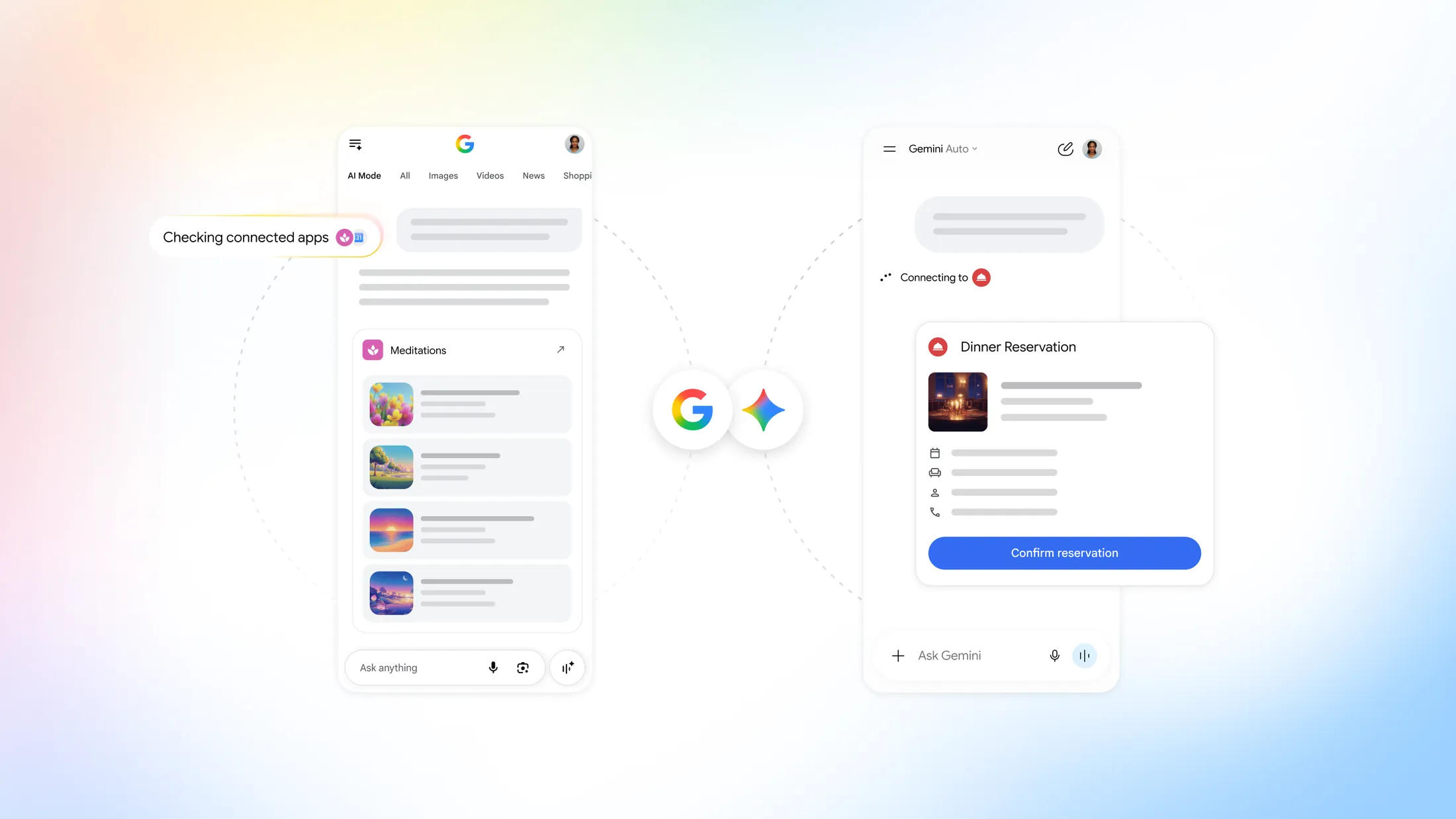
The landscape of generative AI is undergoing a fundamental shift. AI assistants are rapidly evolving beyond static text generation and conversational Q&A, moving aggressively toward real-world, software-driven action. Whether ordering groceries, reserving a table for dinner, or initiating a targeted workout video, users increasingly expect AI interfaces to interact directly with their software stack and execute tasks natively.
To address ecosystem fragmentation and bridge the gap between intent and execution, Google announced the preview launch of its Connected Apps Platform on October 28, 2026. Unveiled by Group Product Managers Chips Mistry (Search) and Mai Lowe (Gemini App), the platform delivers a centralized pipeline for developers to integrate third-party capabilities directly into both Google Search and the Gemini app.
This launch represents a strategic evolution in AI interface design, shifting conversational models from passive answering engines into active, cross-platform control planes for modern software applications.
"Build Once, Reach Everywhere" — Unifying Search and Gemini
Historically, deploying integrations across disparate consumer touchpoints required building separate connectors for Search extensions, conversational bots, and mobile shortcuts. Google's Connected Apps Platform eliminates this engineering tax by introducing a dual-platform deployment model: developers can build a single integration and instantly reach high-intent users across both Google Search and the Gemini app.
Before submitting an app for review, developers retain granular deployment control. Through a single portal, teams can explicitly decide whether an integration goes live in Search, the Gemini app, or both simultaneously.
"From ordering groceries to making playlists, Connected Apps in Search and the Gemini app have made everyday tasks faster and easier."
Analysis: Unifying Search and Gemini under a standardized deployment pipeline dramatically reduces developer overhead while creating context persistence for users. Rather than re-authenticating tools across isolated Google products, consumers gain seamless context-switching—carrying their authorized software integrations across standard Google search queries and open-ended Gemini conversations without breaking stride.
The Technical Backbone — Standardizing on MCP and AppFunctions APIs
Powering these cross-platform capabilities is a standardized, modular technical framework designed for dual-environment execution. Developers build Connected Apps by adopting one of two distinct architectural pathways depending on their target platform and tech stack:
- Cloud-Hosted MCP Servers: Tailored for web services and backend cloud infrastructure, these servers leverage the Model Context Protocol (MCP) to expose external data schemas and actions directly to Google’s hosted AI models.
- Android MCP via AppFunctions APIs: Purpose-built for client-side and on-device execution, this route utilizes Android’s native
AppFunctionsframework to trigger local application actions directly on mobile devices.
Analysis: Google’s commitment to standardizing on protocol specifications like Anthropic's open Model Context Protocol (MCP) signals a critical industry convergence. Rather than locking developers into proprietary, fragile API webhooks, standardizing on open protocols equips generative models with clear, machine-readable tool schemas. This standardized approach allows models to reason over complex multi-step tasks—such as checking meditation schedules or confirming dinner reservations—with reliable software execution guarantees.
Google Connected Console — End-to-End Control and Analytics
To streamline operational management across the developer lifecycle, Google launched the Google Connected Console. This centralized portal handles registration, tool synchronization, sandbox testing, policy review, and post-launch telemetry.
[Developer Console Lifecycle]
Register App ──> Sync MCP Tools ──> Manage Testers ──> Submit for Review ──> Track Live Telemetry
As detailed in IMAGE, the Console interface gives engineering teams precise visibility over their integration state:
- Testing Cohorts & Timestamping: The primary dashboard panel displays status indicators (e.g., "Available to testers" with a defined cohort of "12 testers") along with explicit modification timestamps ("Last updated Oct 28, 2026" and "Last updated 10m ago").
- MCP & Tool Synchronization: A dedicated "MCP and tools setup" section verifies connection state (e.g., showing "MCP - Connected · 5 tools synced" alongside "5 tools available" for an event ticketing app configured as "Tixframe").
- Release & Publication Controls: The "Releases" sidebar manages submission workflows, displaying guiding micro-copy ("Once you're happy with your Connected app, send it to Google for review...") accompanied by explicit call-to-action buttons ("Send for review") and publication status banners ("Your connected app hasn't been published yet").
Post-deployment, the console acts as an operational nerve center, providing real-time telemetry to track request traffic, invocation latency, and error rates while preserving brand identity through verified logos and OAuth-authenticated user accounts.
A 50+ App Ecosystem Burst — Bridging Utility and Generative AI
Google has already deployed over 50 Connected Apps spanning productivity, enterprise software, creative media, health, and lifestyle. Rather than relying on generic web extensions, Google is implementing a structured partner rollout to ensure deep functional utility across consumer domains:
- Productivity & Enterprise Operations:
- Google Workspace: Pulls personalized context across Docs, Drive, and Gmail.
- Bigin by Zoho: Connects AI-powered CRM capabilities for small businesses to manage leads directly inside conversational workflows.
- Creative & Digital Media:
- Adobe: Enables users to create, edit, and refine digital assets and visual designs inside prompts.
- YouTube & Google Photos: Pulls media insights and personalized library context natively.
- Health, Fitness & Lifestyle Services:
- Calm: Launching simultaneously across both Search and Gemini to surface guided mindfulness and meditation content.
- Peloton, Experian & Localiza: Currently live first inside the Gemini app, with expansion to Search rolling out in subsequent weeks.
User Interface Integration Mechanics

- Mobile Surface (
[SOURCE_IMAGE_2]): In Google Search, initiating a query displays an explicit tool-invocation badge ("Checking connected apps") before rendering structured content cards like "Meditations". Inside the Gemini mobile app, queries dynamically trigger a "Connecting to..." indicator, serving actionable cards like "Dinner Reservation" complete with a primary "Confirm reservation" trigger button. - Desktop Surface (
[SOURCE_IMAGE_3]): Accessinggemini.google.comreveals a dedicated Connectors tab under the primary prompt navigation. Users can review and toggle active integrations—including Google Workspace, Search services, Google Photos, YouTube, Adobe, and Bigin—each displaying specific descriptive metadata (e.g., "AI-powered CRM for small businesses. Manage leads,...").
Analysis: Google’s strategic push toward MCP-backed Connected Apps—over legacy web extensions or simple API webhooks—stems from the requirement for semantic intent mapping and structured state management. Traditional web extensions lack cross-platform persistence, requiring separate codebases for desktop browsers and mobile operating systems. By routing integrations through an MCP schema layer, Google ensures that user authorization, context state, and tool schemas persist universally across Search and Gemini mobile and desktop entry points.
Phased Access and the Future of AI Extensions
Google is executing a phased global rollout strategy for the Connected Apps Platform. Initial preview access is targeted at select developer partners, with plans to expand platform availability, regional market reach, and native Google product integrations over the coming months.
Developers seeking to build, test, and register Connected Apps for Google Search and Gemini can apply for early preview access and review technical specifications at developers.google.com/connected-apps.
The Next Phase of Conversational Workflows
The preview launch of Google's Connected Apps Platform marks a decisive milestone in the evolution of conversational interfaces. By standardizing backend communication on MCP and AppFunctions APIs, providing robust lifecycle management via the Connected Console, and unifying deployment across Search and Gemini, Google is laying the structural foundation for true AI agency.
As natural language replaces traditional UI navigation as a primary interaction model, the competitive moat for software platforms will shift from standalone UI design to deep tool interoperability. Developers who standardize their capabilities on open tool protocols today will be best positioned to capture intent in the agentic AI era.
Which everyday app are you most excited to control directly inside your AI assistant?
Comments
Post a Comment