Managing the Digital Deluge
We are currently drowning in a sea of our own making. Between AI-generated assets that require massive training sets, 12K RAW video files that consume gigabytes per second, and "AAA" game installs that rival the size of 20th-century libraries, the modern creator is paralyzed by "data anxiety." The bottleneck is no longer just how much we can create, but how quickly we can move it. At Gamescom 2026 in Cologne, Samsung didn't just launch a new product line; they offered a lifeline to those struggling with the digital deluge. The unveiling of the P-Series USB4 portable SSD lineup signals a fundamental shift in how we perceive external storage—moving it from a passive "backup" drawer to an active, essential gear in the production engine.
The Speed Ceiling Has Been Shattered
For years, the industry hit a plateau with USB 3.2 Gen 2x2. While the previous generation T9 was a respected workhorse, its 2,000MB/s limit felt increasingly like a choke point. In the professional world, the "wait bar" is the most expensive employee in the room; with the P9, Samsung just gave it a pink slip.
By adopting the USB4 architectural foundation, the flagship P9 achieves sequential read speeds of up to 4,000MB/s and write speeds of 3,800MB/s. This isn't an incremental update; it is a doubling of the performance floor. When compared to the 4-terabyte (TB) T9, which capped at 2,000MB/s, the P9 effectively "reshapes the way your data moves." As Tommy Kwon, Vice President at Samsung Electronics, put it:
“As AI-powered content creation and ultra-high-resolution video make large amounts of data part of everyday life, users increasingly expect faster and more reliable storage experiences.”
A Pocket-Sized 8TB Behemoth
Capacity has long been the trade-off for speed, but the P9 eliminates the compromise. It stands as the world’s first 8TB USB4 portable SSD capable of maintaining these 4,000MB/s speeds—a feat of engineering that earned it a CES 2026 Innovation Award.
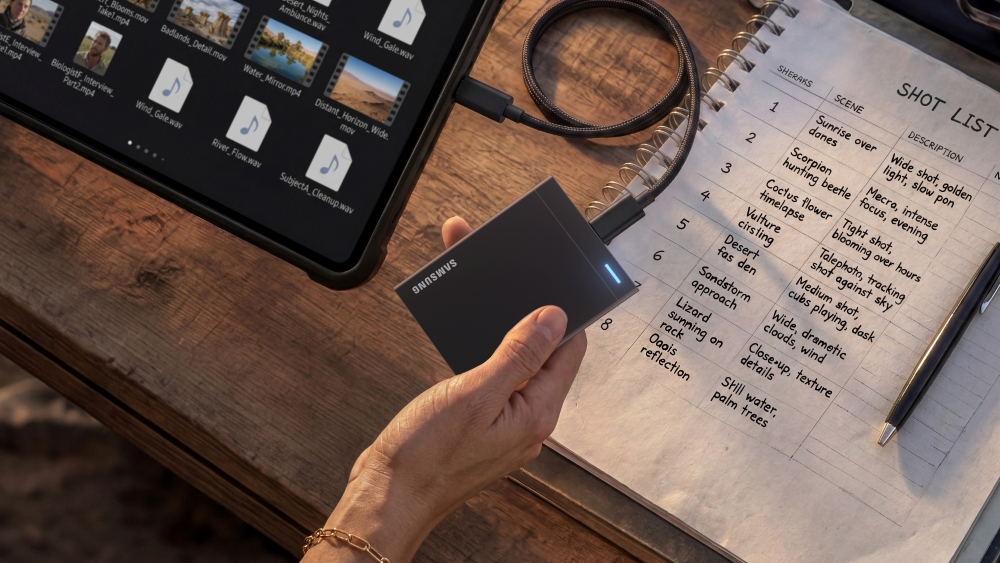
For the filmmaker or researcher, this is the end of the "sneakernet" era. No more carrying a brick-sized RAID array or a pocketful of smaller drives that need constant swapping. This 8TB milestone, marketed under the banner "The edge of your world," represents the consolidation of an entire project's lifecycle onto a device that fits in a shirt pocket.
Workflow Revolution: Sustained 12K Performance
Speed is often marketed through "peak" numbers, but the real test of a professional drive is sustained performance. Most drives throttle their write speeds once the cache is full; the P9 is built to resist that decline. This stability is what enables the holy grail of modern cinematography: direct 12K recording.
“With strong sustained write performance, the P9 supports 12K direct recording for professional production workflows, enabling creators to capture, store, and edit large RAW image files and ultra-high-resolution video.”
By recording directly to the P9, the traditional, time-intensive "offloading" phase is deleted from the schedule. You shoot on the drive, you edit on the drive, and you deliver from the drive. It is a seamless loop that saves hours of billable time.
The P7: Rugged Power for the Everyday Explorer
While the P9 occupies the high-end pedestal, the P7 is perhaps more significant for the broader market. Critically, Samsung did not gatekeep the technology; the P7 also features the USB4 interface, ensuring that even the "entry-level" model is future-proofed against the next generation of laptops and consoles.
The P7 bridges the gap between high-performance tech and the brutal reality of field work. It has survived 2-meter drop testing and features specific shock and vibration resistance. Whether you are a travel vlogger in the Andes or a gamer moving between setups, the P7 provides the same broad compatibility across smartphones, cameras, and consoles, but with a "ruggedized" peace of mind that its faster sibling lacks.
Investment and Accessibility: The Specs at a Glance
Beginning its global rollout on August 31, 2026, the P-Series represents a significant investment. While the $2,699.99 price tag for the 8TB flagship might cause a sharp intake of breath, for the professional capturing 12K RAW, it is a tool that pays for itself in reclaimed hours.
Capacity | P9 MSRP (USD) | P7 MSRP (USD) | Price per TB (P9) | Market Context |
1TB | $339.99 | $289.99 | ~$340 | Entry-level USB4 speed |
2TB | $649.99 | $549.99 | ~$325 | The "Sweet Spot" for creators |
4TB | $1,349.99 | $1,149.99 | ~$337 | Massive project storage |
8TB | $2,699.99 | $2,289.99 | ~$337 | The "World First" Flagship |
Conclusion: The New Baseline for Portable Power
The P-Series doesn't just raise the bar; it moves the stadium. We are entering an era where the distinction between "internal" and "external" storage is becoming irrelevant to the user experience. By combining the massive throughput of USB4 with the unprecedented density of an 8TB footprint, Samsung has turned the portable SSD into an active production powerhouse.
As we move deeper into an AI-driven future where the data we generate is as complex as it is voluminous, the hardware we use must be more than a container. It must be an accelerator. With the P-Series now setting the pace, the only remaining question is: How much faster can you create once the wait bar is gone?
Comments
Post a Comment